




.png?imageMogr2/crop/220x71/gravity/center/format/webp)

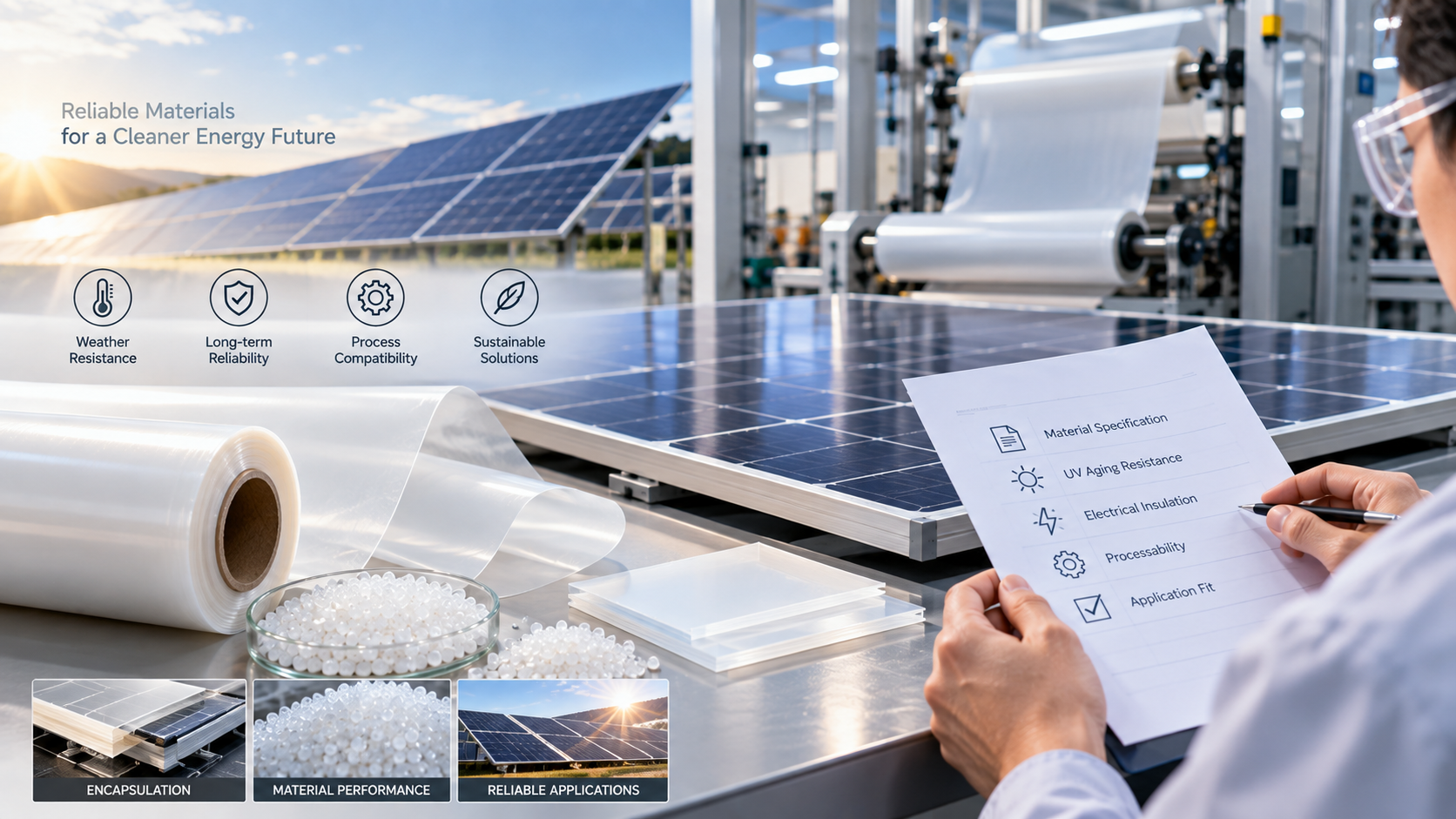
Polyolefin elastomer has become the encapsulant resin of record for high-performance photovoltaic modules, especially double-glass designs and N-type cell platforms, because it combines two properties that are hard to find together: saturated, polar-free chemistry that resists hydrolysis, and a flexible backbone that cushions cells through lamination and decades of thermal cycling. As module warranties stretch toward 25 and 30 years, the encapsulant has stopped being a commodity line item and become a reliability decision.
But a POE grade that laminates beautifully in one factory can fight the line in another, and a resin that passes one lab protocol can underperform in a different climate. The difference rarely shows on a datasheet. It surfaces in the questions you ask — or fail to ask — before selecting the material. This article organizes those questions into a practical confirmation sequence for buyers and material engineers evaluating POE for PV applications, whether you purchase resin for film extrusion or specify encapsulant film for module assembly.
Why POE Selection Is a Chain Decision, Not a Datasheet Choice
In photovoltaics, POE passes through at least two transformations before it protects a cell: resin is compounded and extruded into film, and film is laminated around the cell string. Each step adds a processor whose choices — additives, crosslinking chemistry, film gauge, lamination parameters — shape the final module's fate. A property listed on a resin datasheet is therefore a starting point, not a deliverable.
This has two consequences for buyers. First, you must confirm not just the material properties but the consistency of the whole chain that delivers them. Second, the confirmation questions differ depending on where you sit in the chain: a film producer buys POE resin and needs extrusion behavior; a module maker buys film and needs lamination and reliability behavior. The checks below are framed so both audiences can use them — starting with the one that decides everything else.
Confirm 1: Your Position in the Supply Chain — and the Supplier's
Before comparing grades, be explicit about what you are buying and who stands behind it. Resin buyers should confirm that the supplier produces the POE itself rather than trading it, because formulation support and change control both depend on direct access to the polymer producer. Module-side buyers should confirm what their film supplier's resin source is, and whether it is fixed by contract or subject to substitution.
Chambroad's positioning makes this check straightforward: the company produces its own POE grades — including PV7045 and PV7200, developed specifically for photovoltaic encapsulant film — within an integrated polyolefin platform. For buyers, producer-direct supply means the people answering your processing questions are the people who make the polymer.
Confirm 2: The Processing Window Against Your Lamination Line
The single most common selection failure is choosing a grade whose processing behavior does not match the line it must run on. For film extruders, that means melt flow behavior at your extrusion temperatures, film gauge control at your line speed, and gel or fisheye spot behavior during long runs. For module makers, it means the lamination window: the temperature, vacuum and press-time ranges within which the film flows, crosslinks and wets the cell surface without trapping bubbles or creating voids.
Ask any candidate supplier to state their recommended processing window in writing, and then confirm three things: whether the window was established on equipment comparable to yours, what the sensitivity is at the window's edges, and how the grade's processing behavior is controlled batch to batch. Processing stability is exactly where PV7200 is positioned — its published advantages center on processing performance and product stability, which is the right profile when line consistency is the binding constraint.
Confirm 3: Crosslinking Behavior and the Additive Package
Encapsulant POE is typically crosslinked during lamination to hold gel content, creep resistance and mechanical integrity through a module's service life. The crosslinking system, and the additive package that accompanies it — crosslinking coagents, UV stabilizers, antioxidants — determines how the film behaves in your laminator and ages in the field.
Confirmations that matter:
- Crosslinking depth: what gel-content range does the grade target after standard lamination, and how tightly is it controlled? PV7045 is positioned around high crosslinking and formulation compatibility — the relevant profile when long-term mechanical integrity under thermal cycling drives the specification.
- Formulation compatibility: if you compound or blend, confirm which additives and co-materials the grade has demonstrated compatibility with, rather than discovering incompatibility at production scale.
- Additive disclosure: which stabilizers are included, and at what claim level — because UV and thermal aging performance is only as durable as the package behind it.
Confirm 4: Electrical Insulation and Anti-PID Evidence
The encapsulant is part of the module's electrical insulation system, and volume resistivity under damp heat is the property behind potential-induced degradation (PID) resistance — the failure mode where leakage currents under voltage bias extract ions and corrode cells. POE's non-polar backbone is fundamentally favorable here, but "fundamentally favorable" is not a test result.
Ask suppliers for the electrical evidence behind their claims: volume resistivity at service conditions, dielectric breakdown data, and PID test results on laminates made with the actual film — including the test conditions (temperature, humidity, bias, duration), because PID protocols vary and results are only comparable within one protocol. For module buyers, request the same evidence from your film supplier in the form of laminate-level data, not resin-level assertions. Teams working across energy storage will recognize the same principle in adjacent applications — Chambroad positions POE grades for energy storage batteries on the same logic that electrical-adjacent applications demand documented insulation behavior.
Confirm 5: Compatibility with the Module Stack
The encapsulant never works alone. It contacts glass, cells, ribbon, junction potants and — in double-glass builds — a backsheet or second glass sheet. Selection must therefore confirm compatibility outward in both directions:
- Adhesion: does the film achieve adequate, durable adhesion to your glass coating and cell surface after lamination and damp-heat aging? Adhesion promoters live in the formulation, so ask what surface conditions the grade assumes.
- Additive migration: confirm that stabilizers and processing aids will not migrate into adjacent layers or bloom at edges over temperature cycling.
- Stack-level validation: the decisive question — has this grade been validated in a module stack like yours (same cell type, glass, ribbon and edge seal), and can the supplier share or replicate that validation?
Confirm 6: Durability Evidence for Your Climate and Warranty
A module's warranty is a promise about decades; the encapsulant data behind it usually covers thousands of hours. Bridging that gap requires evidence, arranged in layers: damp-heat aging (for hydrolysis and adhesion retention), thermal cycling (for mechanical fatigue around cells and ribbon), UV exposure (for yellowing and stabilizer consumption), and humidity-freeze combinations that stress the interfaces. Confirm which protocols the material has actually passed, at which durations, and on what laminate construction — then compare against the certification and warranty class you are selling into.
This is also where the supplier's testing infrastructure becomes part of the material decision. A producer who can run micro-to-macro characterization and application-level testing in-house can answer your durability questions with data instead of reassurance — Chambroad's published technical support for its POE line includes shared materials structure analysis and testing platforms, which converts directly into faster, evidence-based answers during qualification.
Confirm 7: Batch Consistency, Delivery and Technical Support
Photovoltaic manufacturing runs on schedules measured in days, and an encapsulant resin that arrives late stops a lamination line, not a laboratory. Confirmations for the commercial side of selection:
- Batch consistency: what is the demonstrated variation across recent production batches in melt index, gel content after standard cure, and additive loading — and which of these appear on the certificate of analysis?
- Delivery reliability: what are lead times at your volume, and what capacity backs them? Both PV7045 and PV7200 are positioned with fast delivery as an explicit advantage — ask what operationally stands behind that claim, from production run length to logistics.
- Specification development: how does the supplier align grade specifications with application requirements? Chambroad documents a standards progression from enterprise to group to industry standards for its POE line — a sign that specifications are anchored to application data rather than internal convenience.
- Joint development: if your module design pushes beyond standard grades, confirm the supplier's path for co-development. Chambroad supports directed product development from pilot through industrial scale, with pre-sales through after-sales technical service — relevant when your next platform needs a grade that does not exist yet.
A Confirmation Checklist Before You Select
| Area | What to Confirm | Evidence to Request |
|---|---|---|
| Supply position | Producer-direct supply, fixed resin source | Production ownership, supply agreement terms |
| Processing | Window matches your extruder or laminator | Written processing windows, edge sensitivity, batch control method |
| Crosslinking | Gel content target, additive disclosure | Gel range and control data, stabilizer package details |
| Electrical | Insulation and anti-PID performance | Volume resistivity at condition, PID test data with protocol stated |
| Stack fit | Compatibility with your glass, cells, edges | Adhesion and migration data, stack-level validation |
| Durability | Aging evidence covers your climate and warranty | Damp heat, thermal cycling, UV results with durations and construction |
| Commercial | Consistency, delivery and support depth | Multi-batch CoA ranges, capacity and lead time, technical service scope |
The pattern across all seven confirmations is the same: in photovoltaics, the cost of a wrong encapsulant decision arrives years later, in a warranty claim, so the selection process must trade short-term convenience for documented evidence at every step. For the underlying material logic, see our article on POE materials and their design advantages, or browse the full POE product line and the broader photovoltaic energy portfolio.
Selecting POE for a photovoltaic program? Contact Chambroad with your module architecture, lamination process and volume, and request the grade options and documentation set your selection file needs.
